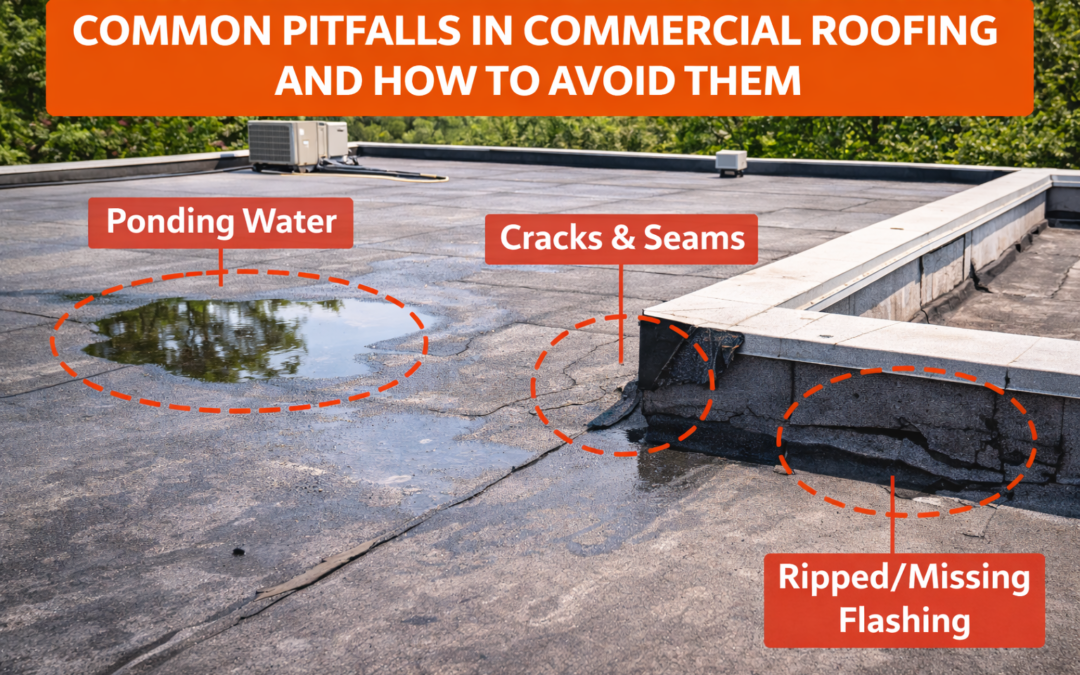
Commercial roofing systems are complex, high-value assets that protect businesses, employees, inventory, and operations. Unlike residential roofs, commercial roofs often span large surface areas, support mechanical equipment, and are exposed to constant foot traffic and environmental stress. Because of this complexity, commercial roofing projects are particularly vulnerable to costly mistakes.
Many commercial roofing failures are not caused by extreme weather alone but by avoidable errors in planning, installation, maintenance, and decision-making. Understanding these common pitfalls and how to prevent them is essential for property owners, facility managers, and developers who want to maximize roof lifespan, control costs, and avoid disruptions.
This guide explores the most frequent commercial roofing mistakes, explains why they occur, and provides clear strategies to avoid them.
Why Commercial Roofing Requires a Different Approach
Commercial roofs differ significantly from residential systems in both design and performance requirements. Most commercial buildings use flat or low-slope roofs that rely on membranes, drainage systems, and structural engineering rather than simple water shedding.
Key characteristics of commercial roofing include:
Large surface areas that amplify small failures
Complex drainage systems
Rooftop HVAC and mechanical equipment
Frequent foot traffic for maintenance
Longer expected service life
Because of these factors, small oversights can quickly escalate into major structural and financial problems.
Pitfall 1: Choosing the Wrong Roofing System
One of the most common mistakes in commercial roofing is selecting a system based on initial cost rather than suitability.
Why This Happens
Budget pressure during construction or renovation
Limited understanding of roofing system differences
One-size-fits-all recommendations
Consequences
Premature roof failure
Increased maintenance and repair costs
Poor performance under local climate conditions
How to Avoid It
Select a roofing system based on:
Building use and occupancy
Climate and weather exposure
Roof slope and drainage design
Expected foot traffic and equipment load
An experienced commercial roofing professional evaluates these factors before recommending a system.
Pitfall 2: Inadequate Roof Drainage Design
Poor drainage is one of the leading causes of commercial roof failure.
Common Drainage Issues
Ponding water
Clogged drains or scuppers
Improper slope design
Undersized drainage components
Why It Matters
Standing water accelerates membrane deterioration, increases structural load, and heightens leak risk. Even roofing systems rated for ponding water suffer reduced lifespan if drainage issues persist.
How to Avoid It
Ensure proper slope during design or retrofit
Install sufficient drains and overflow systems
Schedule routine drain cleaning and inspections
Address ponding issues promptly
Drainage should be considered a core design element, not an afterthought.
Pitfall 3: Poor Installation Practices
Even high-quality materials fail when installation standards are not followed.
Common Installation Errors
Improper seam welding or bonding
Incorrect fastener placement
Inadequate flashing installation
Skipped manufacturer specifications
Consequences
Early leaks
Reduced wind resistance
Voided warranties
Costly rework
How to Avoid It
Hire contractors with proven commercial roofing experience and documented quality standards. Roofing excellence is achieved through precision, consistency, and accountability principles exemplified by Award-Winning Roofing Service Excellence where workmanship, compliance, and performance are treated as non-negotiable standards.
Pitfall 4: Ignoring Manufacturer Requirements
Manufacturers design roofing systems as complete assemblies. Deviating from specifications compromises performance.
Why This Happens
Untrained installers
Time pressure
Cost-cutting shortcuts
Risks
Warranty denial
Reduced lifespan
Unpredictable performance
How to Avoid It
Ensure:
Certified installers are used
Approved materials and accessories are installed
Documentation is maintained
Manufacturer compliance protects both performance and investment.
Pitfall 5: Neglecting Regular Maintenance
Many commercial roofs fail not because of defects, but because small issues are ignored.
Commonly Overlooked Maintenance Tasks
Clearing debris from drains
Inspecting flashing and seams
Checking roof penetrations
Monitoring membrane wear
Why It Matters
Minor issues become major repairs when left unaddressed. Regular maintenance can double the effective lifespan of a commercial roof.
How to Avoid It
Implement a structured maintenance program that includes:
Biannual inspections
Post-storm assessments
Documented repair history
Maintenance is far less expensive than emergency replacement.
Pitfall 6: Poor Flashing and Detailing
Flashing failures account for a significant percentage of commercial roof leaks.
High-Risk Areas
HVAC curbs
Vents and penetrations
Parapet walls
Roof-to-wall transitions
Why Flashing Fails
Improper materials
Inadequate fastening
Lack of flexibility for movement
How to Avoid It
Flashing should be:
Custom-fabricated where necessary
Compatible with roofing membranes
Installed by experienced professionals
Attention to detail at transitions is critical.
Pitfall 7: Overlooking Roof Load and Structural Capacity
Commercial roofs must support more than weather exposure.
Common Load Issues
HVAC equipment additions
Solar panel installations
Snow accumulation
Water ponding
Consequences
Structural stress
Deck deflection
Membrane failure
How to Avoid It
Before adding equipment or modifying roof use:
Conduct structural assessments
Consult engineering professionals
Upgrade roofing systems when necessary
Roof load planning is essential for long-term safety.
Pitfall 8: Delaying Repairs After Damage
Small leaks or surface damage are often underestimated.
Why Delays Occur
Operational priorities
Budget concerns
Underestimating severity
Risks
Mold growth
Insulation saturation
Structural degradation
How to Avoid It
Address damage immediately, even if only temporary repairs are possible. Early intervention limits repair scope and cost.
Pitfall 9: Choosing Contractors Based on Price Alone
Lowest-bid selection often leads to long-term losses.
Why This Is Risky
Inexperienced crews
Inferior materials
Lack of accountability
How to Avoid It
Evaluate contractors based on:
Commercial roofing experience
Safety records
References and portfolio
Warranty and service support
Value is measured in performance, not just price.
Pitfall 10: Failing to Document Roofing Work
Lack of documentation creates confusion and risk.
Why Documentation Matters
Warranty validation
Insurance claims
Maintenance planning
Asset management
How to Avoid It
Maintain records of:
Installation details
Inspection reports
Repairs and modifications
Manufacturer certifications
Good documentation protects your investment.
Pitfall 11: Ignoring Climate and Environmental Factors
Commercial roofing must be adapted to local conditions.
Environmental Stressors
Heavy rainfall
Freeze-thaw cycles
UV exposure
Wind uplift
How to Avoid It
Select materials and systems designed for local climate demands and install them with appropriate reinforcements.
Pitfall 12: Underestimating Roof Access and Traffic
Commercial roofs often double as service platforms.
Traffic-Related Issues
Membrane punctures
Compressed insulation
Accelerated wear
How to Avoid It
Install walkway pads
Limit unauthorized access
Train maintenance personnel
Protecting high-traffic areas preserves roof integrity.
Pitfall 13: Treating Roofing as a One-Time Expense
Roofs are long-term systems, not single-event purchases.
Why This Mindset Fails
Ignores lifecycle costs
Leads to deferred maintenance
Increases emergency repairs
How to Avoid It
Adopt a lifecycle approach that considers:
Installation quality
Maintenance planning
Repair strategy
Replacement timing
This approach reduces total ownership cost.
The Role of Professional Standards in Avoiding Pitfalls
Avoiding commercial roofing mistakes requires more than materials. It requires a commitment to best practices, accountability, and continuous improvement.
Roofing companies that operate under recognized standards of excellence focus on:
Proper system selection
Precision installation
Safety compliance
Transparent communication
Long-term performance
This philosophy underpins Award-Winning Roofing Service Excellence, where commercial roofing is approached as a critical building system rather than a commodity.
Conclusion: Preventing Commercial Roofing Failures Starts With Knowledge
Commercial roofing failures are rarely sudden or unavoidable. Most are the result of predictable and preventable mistakes made during planning, installation, or maintenance. By understanding these common pitfalls and taking proactive steps to avoid them, property owners and facility managers can dramatically extend roof lifespan, reduce operational risk, and protect their investments.